


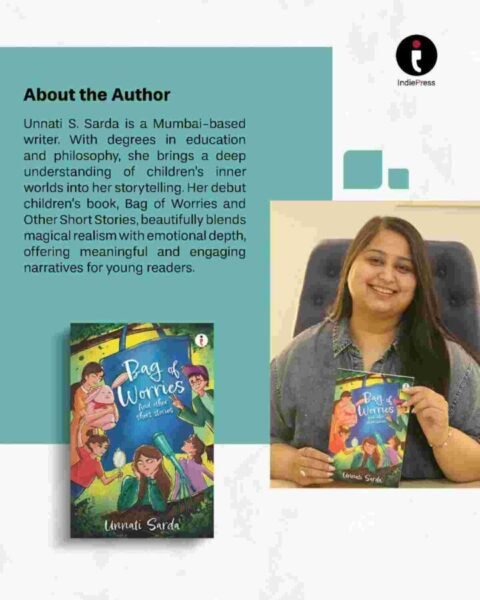
This collection of five emotionally rich short stories for children explores the depth, sensitivity, and imagination of young minds. Blending everyday realities with gentle magical elements, the book reflects on how children experience complex emotions such as grief, self-worth, insecurity, and joy.
Each story carries a distinct emotional tone, gently guiding readers toward understanding and overcoming difficult feelings. Designed as a soothing and reflective reading experience, the book nurtures emotional awareness while encouraging imagination, empathy, and inner strength.
1. What inspired you to write for a younger audience, and how do you approach crafting a story that resonates with children?
My experiences as a sensitive child and as a primary school teacher showed me that people often underestimate how deeply children can feel. They are true observers, often more attuned and perceptive than adults. Children may not always have the words for what they sense, but they absorb everything happening around them. Childhood is emotionally profound, and I want to tell stories that honour the rich inner worlds of young people.
2. Children’s books often carry important messages. Can you tell us about the themes or values you aimed to convey in your latest book?
The central theme across the five stories is that feelings move us in unexpected directions, and that we can rise above difficult emotions. Each story carries its own emotional signature, gently unfolding complexity. Although magical elements are present, the stories are grounded in real-life emotions and experiences.
3. Illustrations play a crucial role in children’s books. How did the collaboration with the illustrator enhance the storytelling, and what was the creative process like?
This was a first for me. I truly enjoyed discussing the design and illustrations, which strengthened my belief in the vision. It was inspiring to see how naturally the artist understood the writing. The design team ensured that colours and facial expressions reflected the characters’ emotions. Each story has a distinct colour palette that aligns with its mood and essence.
4. Connecting with young readers is essential. How do you strike a balance between entertaining and educating in your children’s books?
Fiction is both entertaining and educational in varying measures. I have tried not to make the stories moralistic or preachy. Instead, they naturally offer what the reader needs in the moment. This book is not meant to be purely entertaining; it is more reflective and soothing, best enjoyed as a bedtime read or during quiet moments.
5. Your characters are charming and relatable. How do you create characters that children can identify with, and do they draw from your own childhood experiences?
Not intentionally, but I am sure the characters reflect my child self in many ways. Childhood emotions are universal, which is why children’s books resonate across ages. I begin by identifying the core emotion of the story, build a scenario around it, and then imagine the character who would navigate and overcome it. This is how I saw Gini, Eila, Tara, Kai, and Fiza—the sensitive, thoughtful ones who needed a gentle nudge of magic to overcome their inner worlds.
6. In the digital age, children have various forms of entertainment. How do you see the role of children’s books in fostering a love for reading and storytelling?
The digital age can be overwhelming for the mind. While adults may turn to meditation, children need books, games, dance, and song. Despite the abundance of digital entertainment, deeply engaging experiences remain essential. Reading books provides reflective, meaningful engagement, especially when stories are read aloud or enacted like a play.
7. The language and writing style in children’s books are distinct. How do you tailor your writing to engage young readers while maintaining sophistication that can grow with them?
I have tried to keep my writing style gentle and imaginative. The short stories are written in a spoken storytelling style with emotion-forward narration. The narrator remains deeply aware of the characters’ inner worlds while also describing external events, allowing readers to connect both emotionally and imaginatively.
8. Family and educators often play a role in introducing children to books. How do you envision your books being used in educational settings or as part of family reading routines?
This collection is emotionally soothing and restorative. I imagine it being read as a bedtime ritual or during quiet family bonding time. I also see friends reading it together and sharing emotional reflections. Teachers and counselors can use these stories to open conversations about emotional health and mindfulness, helping children discuss grief, self-worth, insecurity, and guilt through fiction.
📚 Now available on Amazon — Bag of Worries and Other Short Stories by Unnati Sarda.
Step into a world of emotion, imagination, and gentle magic today.
