


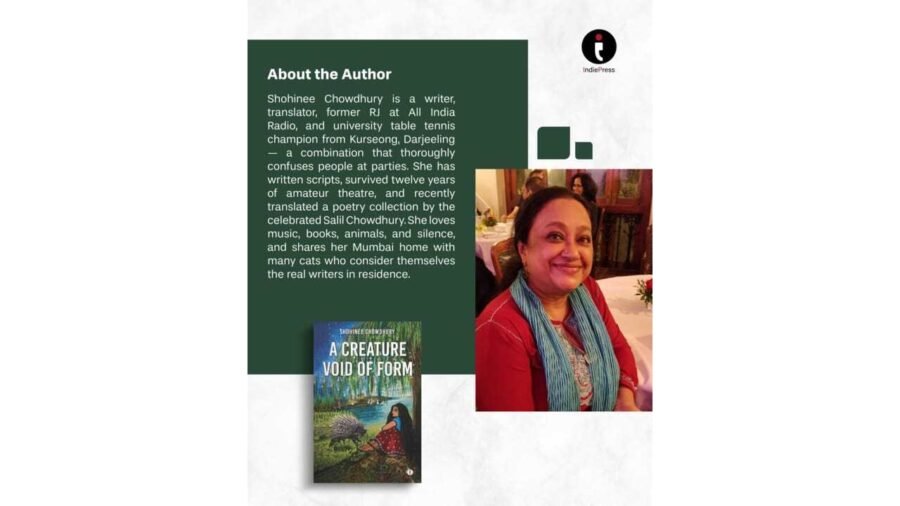
A Creature Void of Form is a deeply personal poetry collection that explores womanhood, identity, memory, and the quiet intensity of human emotions. Through vivid imagery inspired by nature and deeply introspective verse, Shohinee Chowdhury transforms personal experiences into poetry that resonates far beyond the page. Rather than writing with an audience in mind, she embraces honesty as her guiding principle, allowing every poem to emerge naturally from lived experience.
Drawing inspiration from the women who shaped her life, the landscapes of Kurseong, and the rhythms of Bangla, Nepali, and Western music, Chowdhury creates poetry that is both lyrical and profoundly intimate. Her verses weave together themes of empathy, resilience, solitude, and self-discovery, inviting readers to pause and reflect on emotions that often remain unspoken.
Rich in metaphor and rooted in authenticity, A Creature Void of Form is a celebration of poetry as a deeply personal form of expression. It reminds readers that the most powerful writing often comes not from a desire to impress, but from the courage to express life exactly as it is felt.
1. What draws you to poetry as your preferred form of expression?
Poetry, I find, is very succinct. It does not waste time and gets to the point quickly. As a person, I do not beat around the bush when dealing with anything in life, and therefore I find an honesty in poetry that I sometimes do not find in other forms of expression.
Sometimes, it is not possible to portray deep emotions without using imagery or metaphors, and poetry helps me convey my thoughts better.
2. What inspired the themes and emotional depth of your poetry collection?
I have grown up surrounded by many women—my mother, aunts, cousins—each with different experiences and stories to tell. My friends added to this with their own experiences. Being a very empathetic person, I often felt as though I had lived the experiences they shared with me.
The theme of my book stems from what I found in their lives, but mostly from my own. The tone and structure came naturally from what I was trying to express. They were never overanalysed or carefully planned; they simply evolved with the poems themselves.
3. Your poems feel deeply personal, yet many readers connect with them. How do you balance the personal with the universal?
I do not think I consciously tried to cater to a universal audience. I wrote in a very personal and subjective manner. In fact, I never intended to publish what I wrote, so I never tried to shape my experiences to suit an audience.
I simply wrote. My friends who read my poems connected with them for reasons of their own. Later, I thought that perhaps people I did not know might also find something meaningful in them.
4. Your poetry has a distinctive rhythm and lyrical quality. How has music influenced your writing?
I grew up surrounded by music. My parents and siblings had music playing during almost all waking hours. We listened mainly to Bangla and Western music across many genres.
Melody and lyrics became an integral part of my psyche. Perhaps that natural cadence found its way into my words. I also grew up speaking two beautiful languages—Bangla and Nepali—and I believe their rhythm and musicality are reflected in my poetry.
5. Nature appears vividly throughout your work. How has your upbringing influenced your imagery?
Most of my poetry is born from my own life. I grew up in the hills of Kurseong, surrounded by forests and mountains. My childhood was spent watching spiders weave their webs and seeing the mountains transform into shades of green every spring after winter, rather than spending my time in front of a television.
The imagery in my poems comes directly from those memories. Studying English Literature during my Master’s further helped me bring those images alive and paint them vividly with words.
6. What role does poetry play in expressing your thoughts and engaging with the world around you?
I never consciously set out to reflect the world around me or communicate my thoughts to others. I wrote simply because writing felt as natural to me as eating or drinking. It became the gentlest way of expressing what I truly felt without being blunt or hurtful.
For most of my life, I never intended to share my writing publicly. Perhaps that is why I am publishing so late in life. The people closest to me encouraged me to share my work, and only then did I decide to let others read my poems.
I have always been something of a loner, so my writing was largely for myself—a way of venting emotions or giving voice to someone else’s experiences. At times, however, poetry also became a medium through which I expressed my views on issues that deeply stirred me, especially the treatment of women across history, mythology, and society.
7. Do you have a writing routine or creative ritual?
I do not have any particular ritual. I dislike being tied to routines of any kind. I write when I feel like writing. Sometimes I do not write for months, while at other times I may write three poems in a single day.
Any strict routine would make me feel claustrophobic. I believe spontaneity and freshness are essential to creativity. While discipline is important for professionals, I have always written simply to express myself, without any agenda. So whenever inspiration arrived—regardless of the time or place—I wrote.
Discover a poetry collection shaped by personal truth, nature, music, and the timeless experiences of womanhood.
Order your copy of A Creature Void of Form by the Author Shohinee Chowdhury today on Amazon and experience poetry that speaks with quiet honesty and lasting resonance.
